
Commercial MEES is changing.
In June 2026, the government confirmed its intention to introduce a more targeted standard for privately rented non-domestic property in England and Wales.
From 2031, privately rented non-domestic buildings over 1,000 m² are proposed to need an EPC B where cost-effective.
Buildings below 1,000 m² are intended to remain subject to the existing minimum EPC E standard.
And the previously proposed EPC C milestone for 2027 will not go ahead.
What is proposed?
Over 1,000 m²
EPC B from 2031, where cost-effective.
Below 1,000 m²
The existing EPC E minimum is intended to remain.
2027 EPC C milestone
No longer being taken forward.
Seven-year payback and exemptions
The government intends the existing flexibility mechanisms to remain.
Importantly, the proposed EPC B requirement is not yet in force. The government has stated that the change will require secondary legislation through Parliament.
The portfolio question
For commercial property owners, the headline EPC target is only the starting point.
Across a large portfolio, the more useful questions are:
Which assets are actually in scope?
Which are already at or above B?
Which EPCs may be stale?
Which properties should be reassessed before Capex is committed?
Which improvements are cost-effective?
Where might an exemption apply?
Which assets actually deserve capital?
That turns MEES from a certificate exercise into a portfolio prioritisation problem.
From 367 properties to four priorities
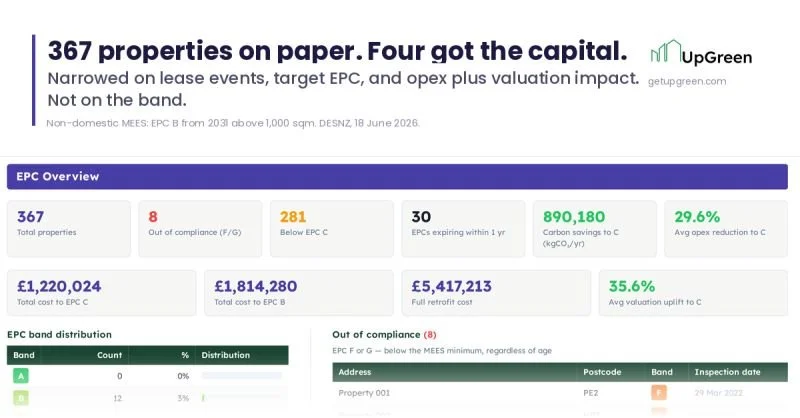
Portfolio-level MEES screening across a 367-property logistics estate, narrowing the initial estate to the assets requiring active attention.
In one logistics estate, we analysed 367 properties. The initial screening identified 16 paper priorities.
After considering factors including lease events, EPC position and investment economics, that narrowed to four assets requiring active attention.
The important point was not simply how many properties sat below a particular EPC threshold.
It was determining where action was actually justified.
A building below EPC B does not automatically equal a retrofit project.
A stale certificate, reassessment opportunity, exemption or poor investment case can materially change the appropriate decision.
Where UpGreen fits
UpGreen creates the initial portfolio picture.
Starting from an address list, we help owners and advisers identify:
EPC and MEES exposure
Potentially affected properties
Stale certificates and reassessment opportunities
Indicative retrofit pathways and Capex
Potential exemption routes
Portfolio priorities
Better client data, surveys and professional assessments can then progressively refine the analysis.
UpGreen does not replace EPC assessors, surveyors or professional advisers.
It helps determine where their expertise — and the owner’s capital — should be deployed first.
Start with the portfolio
2031 may still be several years away, and the final EPC B framework remains subject to legislation.
But owners do not need to wait until the deadline to understand their portfolios.
The useful starting question is:
Which buildings are likely to matter, what might they require, and where should we investigate first?
This page provides general information and does not constitute legal, regulatory, engineering or professional property advice. The proposed EPC B standard remains subject to secondary legislation. Property owners should refer to current government guidance and obtain appropriate professional advice.
